
Glenview City Directory Holdings
Glenview has no single complete digital shelf. The Glenview Public Library local-history collection supplies the broadest local run, while regional scans fill selected early years. Coverage dates describe the collection, not a promise that each issue or page survives. Record the volume year and page before moving to another source.
| Collection | Years | Where Held | Access |
|---|---|---|---|
| Telephone books | 1906 to present | Glenview Public Library | In-library and reference help |
| Haines North Suburban Directories | 1967 to present | Glenview Public Library | In-library; verify issue completeness |
| Regional telephone books | Selected 1924 to 1959 issues | Skokie History Digital Collections | Free online scans |
| Glenview-area newspapers | 1928 to present | Library, Hibbard, databases | Issue, date, and page search |
| Glenview Obituary Index | 1849 to 1995 resource range | Glenview Public Library | Index lead; locate original issue |
A true public, Glenview-specific criss-cross index was not confirmed. A criss-cross book arranges entries by street rather than by surname. Ask the library for a particular year and address instead of assuming that every Haines volume has reverse pages. The city directory trail is strongest when a print entry, newspaper item, and parcel or deed date agree.
Glenview Directory Research Room
The Genealogy and Local History Room sits on the library's second floor. Its holdings extend beyond city directories to Glenbrook and Loyola yearbooks, maps, school and church histories, newspapers, and the Gertrude Lundberg Collection. Ancestry Library Edition is available only in the library; Fold3, HeritageQuest, Newspapers.com, and FamilySearch Affiliate access have their own terms. Call the Reference Desk at 847-729-7500 ext. 7700 when a year or format is unclear.
The library home page shows the institution behind that research service.
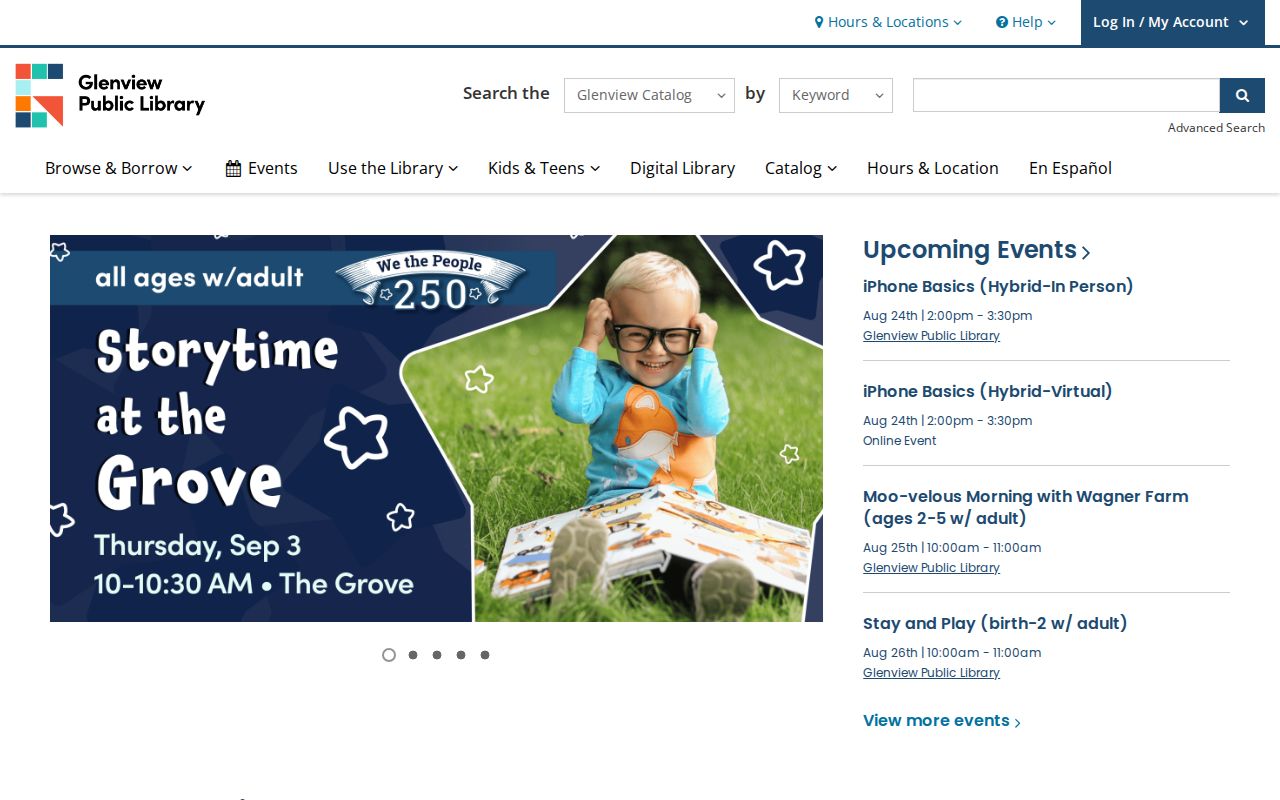
The library is the practical first stop for a volume that is not online and for help checking whether a dated run has gaps.
The library genealogy database list also separates local indexes from licensed research tools.
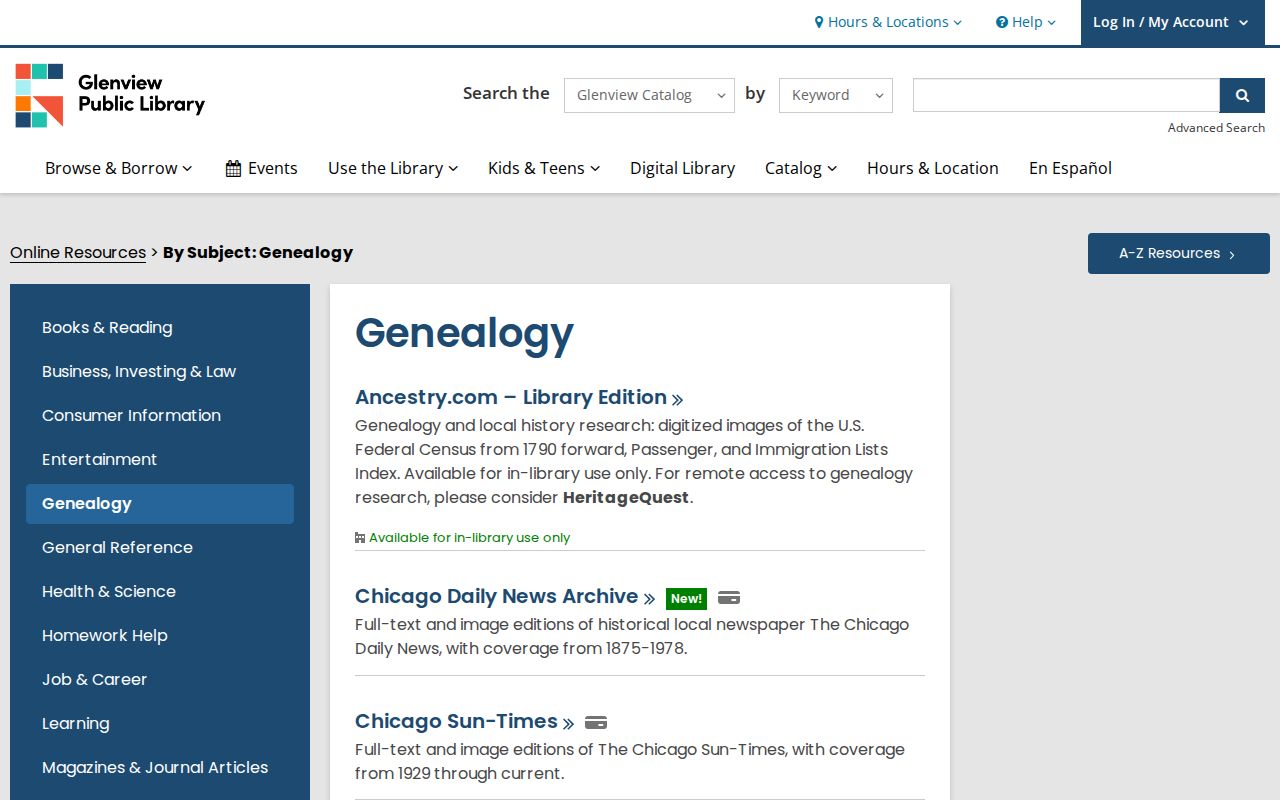
That distinction matters because a catalog date range and a searchable full-text run are not the same thing.
Digitized Glenview Directory Years
The regional telephone-book collection lists selected issues from 1924 through 1959, including books for Glenview and Northbrook. The years are not continuous. Browse the dated list first, then open the most useful scan.
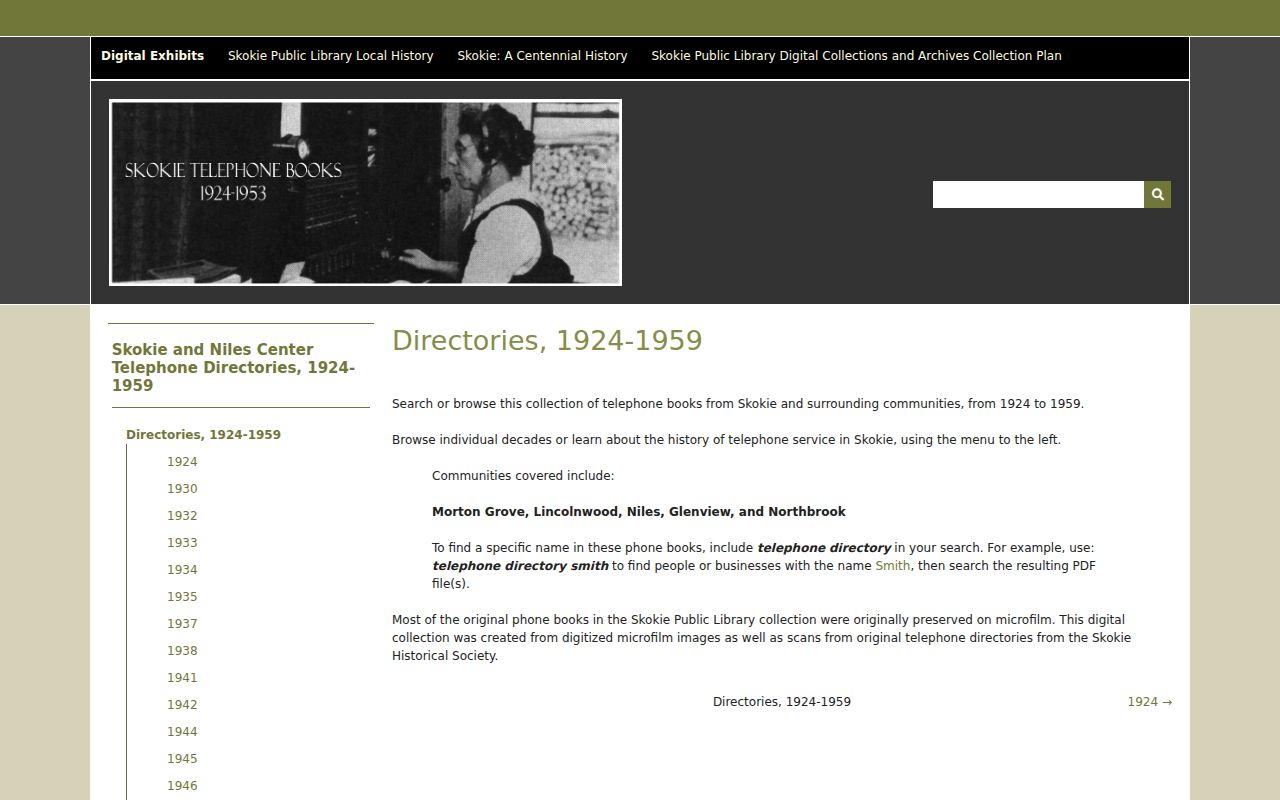
The browse page makes missing years visible and prevents a failed name search from being mistaken for proof that a person was absent.
The July 1930 telephone directory places the Glenview and Northbrook section near page 24 and offers search, PDF, and page-browse controls.
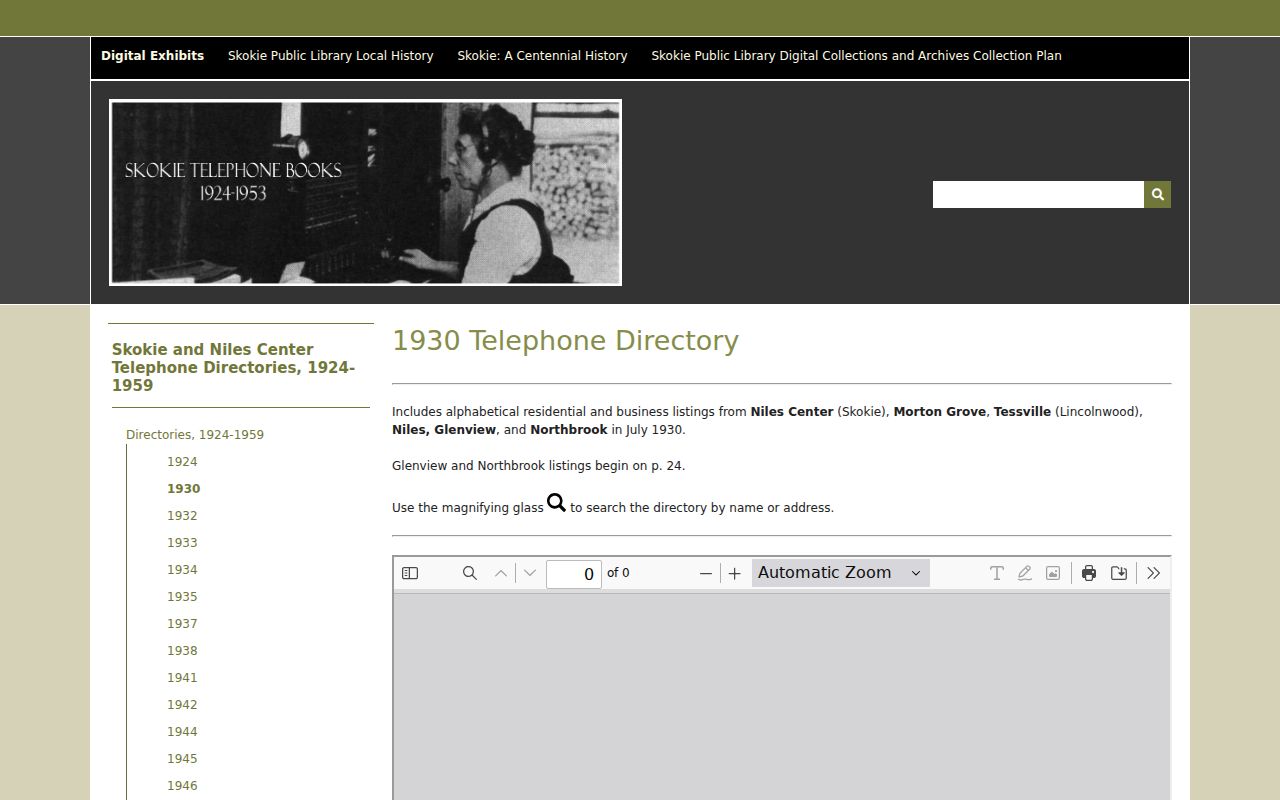
Its alphabetical residential and business listings are a dated snapshot. Save the scan page and printed heading with any transcription.
Read Glenview Directory Entries
A Glenview city directory entry should be copied as a small record, not reduced to a name. Capture the publication, year, page, exact spelling, address text, and phone number. Older regional books mix residential and business listings. They may omit household members, unlisted numbers, or recent moves. Never add an occupation, spouse, ownership mark, or renter symbol unless the abbreviation key for that exact volume defines it.
| Printed name | Preserve initials, spelling, and ordering as shown. |
|---|---|
| Telephone | Record the old exchange or number without modernizing it. |
| Street line | Copy the number, street, suffix, and printed postal line. |
| Listing type | Note whether the page identifies a residence or business. |
| Citation | Save title, issue year, section, and image or print page. |
- Criss-cross directory
- A volume or section ordered by street and house number, useful when the address is known.
- Householder index
- A list centered on the named person associated with a household, not a complete roster of occupants.
- Abbreviation key
- The volume's own explanation of shortened words and symbols. Copy it before interpreting an entry.
Note: No confirmed online criss-cross run covers every Glenview address, so ask local reference staff about the exact year needed.
Hibbard Preserves Glenview Records
The Glenview History Center research room at Hibbard Library, 1121 Waukegan Road, holds rare books, documents, photos, maps, artifacts, newspapers, census material, and obituaries. Research help is available at 847-724-2235, with posted Hibbard hours Tuesday from 1 to 5. The Sarah Hutchings farmhouse and its later Schur and Homan links also give house researchers a documented local anchor.
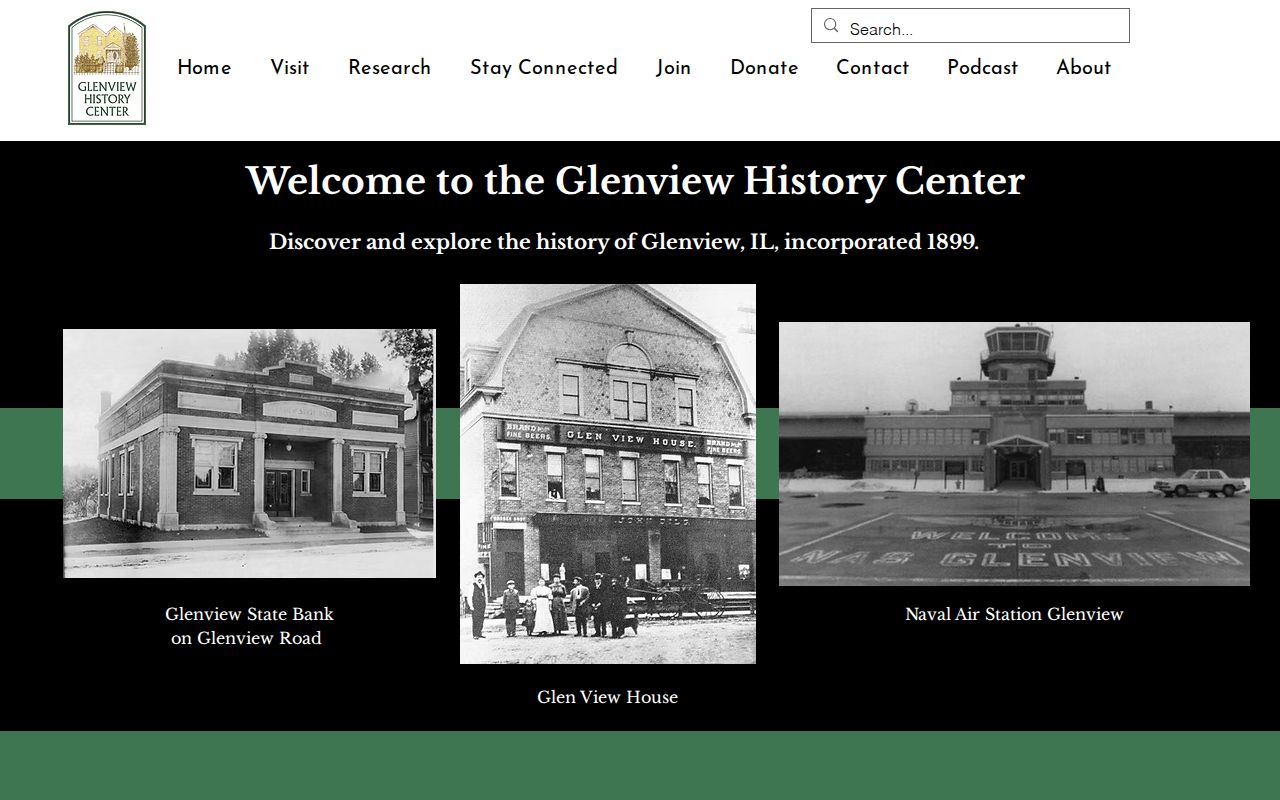
The History Center can supply context that a bare city directory line lacks, including maps, oral histories, neighborhood files, and dated photographs.
The Village history page provides the official municipal timeline used to date those sources.
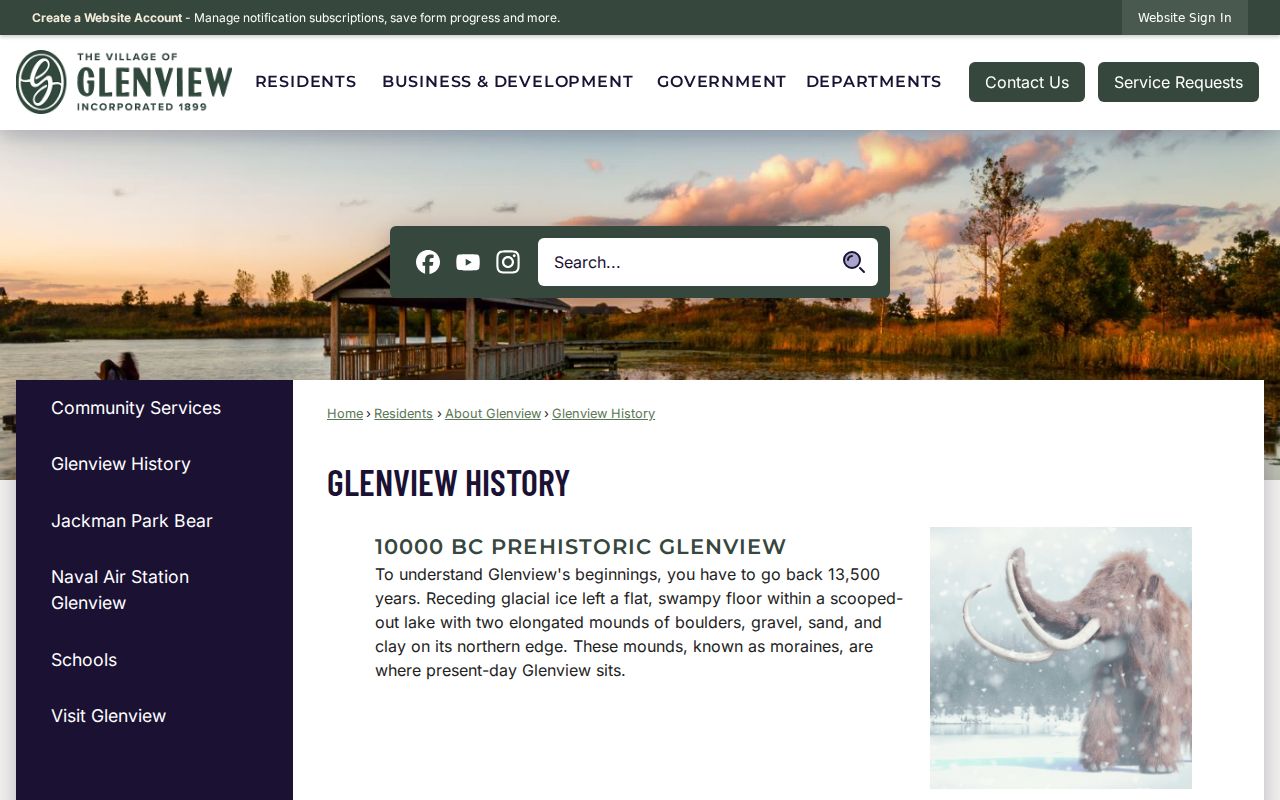
Use that timeline as context, then cite the actual directory, newspaper, map, or archival item that supports a person or address claim.
Glenview Obituaries Extend Directories
The library's obituary index covers an 1849 to 1995 resource-page range. Treat each result as a pointer. Locate the newspaper title, issue date, and page, then read the article. Obituaries may name relatives, old addresses, civic groups, and dates, but they are secondary accounts and can contain errors.
Glenview-area newspaper holdings begin in 1928 at the library. The Illinois Newspaper Project locator also identifies titles such as Glenview View, Glenview Post, Post & View, Glenview Times, Glenview News/Voice, Glenview Journal, and Glenview Announcements. The locator's “9999” value means open-ended coverage, not a future publication year. A lawful vital record, probate file, cemetery record, or original newspaper page should confirm a key fact.
Glenview Directory Time Markers
Local events help explain why the same place may appear under different descriptions. They do not rewrite the entry itself.
| Date | Research marker |
|---|---|
| 1899 | Glenview incorporation vote and first Village Board. |
| 1906 | Start of the library's stated telephone-book holdings. |
| 1924 | First listed year in the regional digital directory run. |
| 1967 | Start of stated Haines North Suburban Directory holdings. |
| 1995 | Naval Air Station Glenview closed, preceding The Glen redevelopment. |
The airfield-to-neighborhood change is especially important. A mid-century phone book, military-era map, and current parcel map describe different record worlds in the same broad area.
Trace Family Through Glenview Directories
Family research works best as a dated chain. City directories can bridge the years between federal census schedules, while newspapers and deeds test whether two similar names describe the same person.
- Find the earliest available alphabetical entry and save a full citation.
- Check the next available issue, recording each spelling, phone, and address change.
- Compare the nearest census year and distinguish people with the same name by age and family group.
- Test the address against maps and dated county property records without treating an owner as an occupant.
- Follow disappearance from the run with the obituary index, newspaper pages, probate, or a later directory.
A missing entry can mean a move, death, name change, unlisted phone, publication gap, or search error. It is not a conclusion. If a volume is unavailable online, phone the library or History Center, request an item-level finding aid by year and address, or ask about reproduction by mail or email. Historical society collections are accessed under their own reference rules, not through the Illinois Freedom of Information Act. For modern address-keyed work, shift to the Glenview street directory method rather than stretching an old listing beyond its date.
Build a research log as the chain grows. Give each line a source title, issue date, page, access date, and exact text. Keep a separate column for interpretation. That simple split prevents a modern spelling or ZIP from leaking into a historical transcription. When two books disagree, preserve both entries and check the newspaper nearest the move date. A deed can establish a recorded land interest, but it still does not prove that the named party occupied the address.
Remote research has limits. Online scans and databases are the first channel, while the library phone desk and Hibbard volunteers cover the in-person route. Mail or email requests should name one person, one address, one year range, and the likely collection. Cook County Clerk records, Illinois vital forms, the State Archives, and court archives are separate custodian channels. Fees and eligibility depend on the record requested, so a directory citation should lead to the right office rather than act as a substitute for its record.
Use nearby sources to test each change in the directory run. Glenview newspapers can date a move, business, school event, or obituary lead. Village history files can explain a renamed place or new subdivision. A recorded deed can connect a party to land on a specific date, while a census schedule can describe a household in its released year. None should overwrite the directory entry. Keep each source in its own dated row, then state only the link that the records actually support.